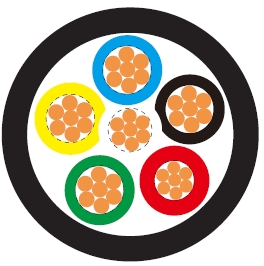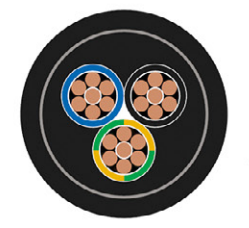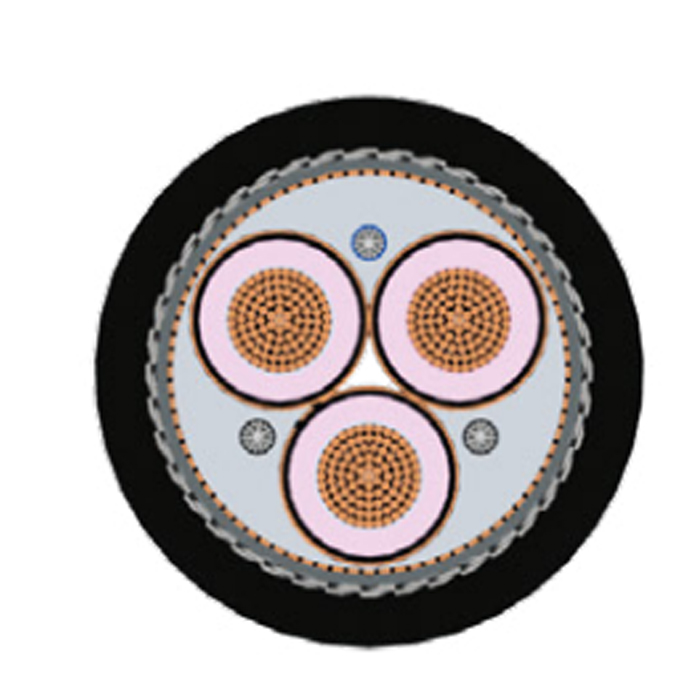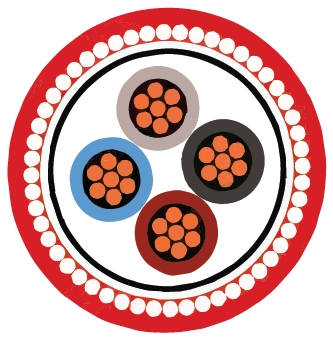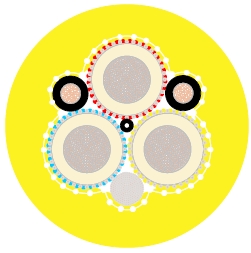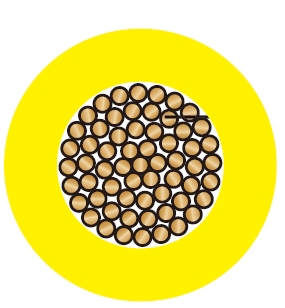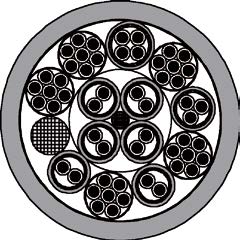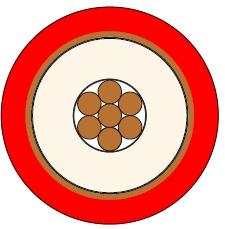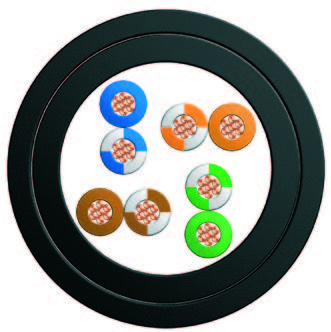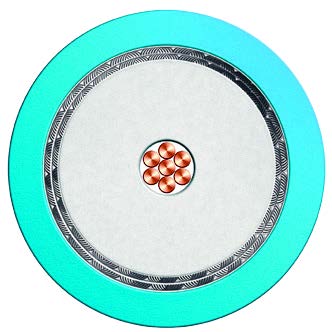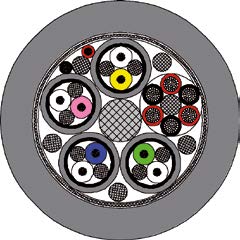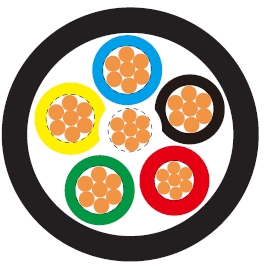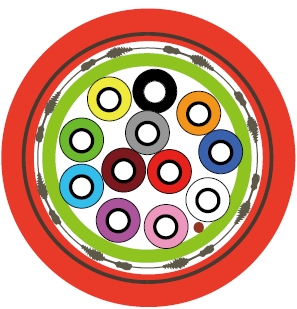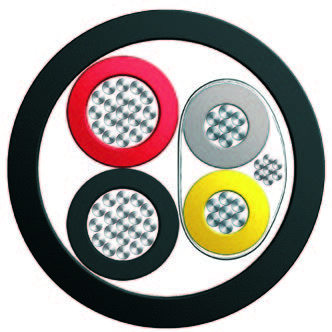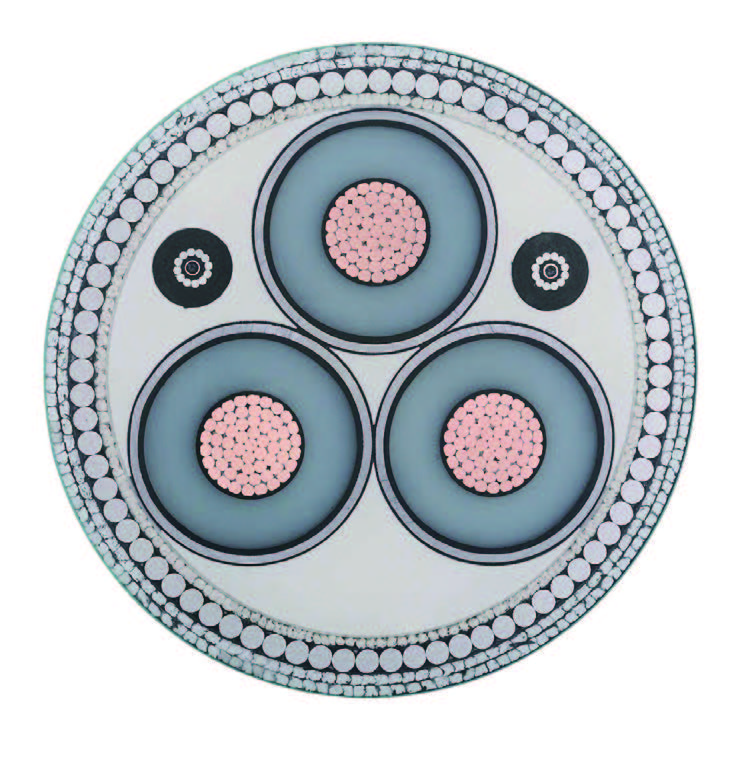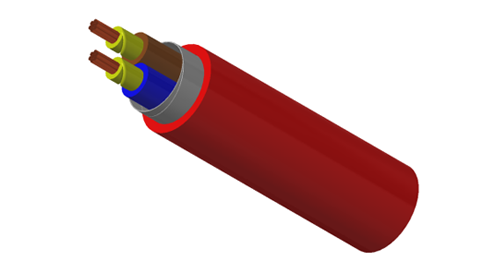
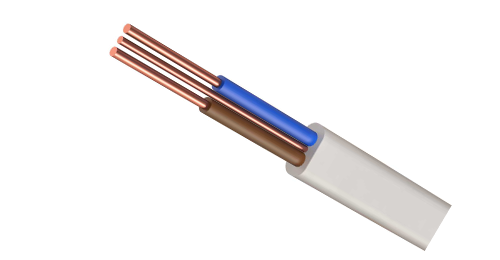
BURYCABLE FirePro 300/500V Mica XLPE LSZH cable
is designed for fixed installations where
circuit integrity under fire conditions
is specified.
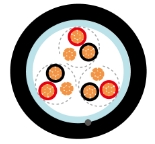
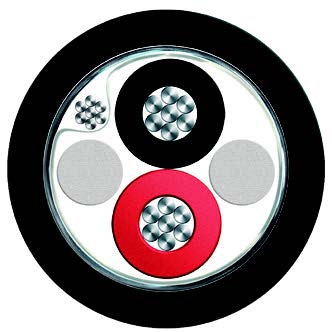
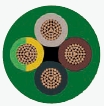
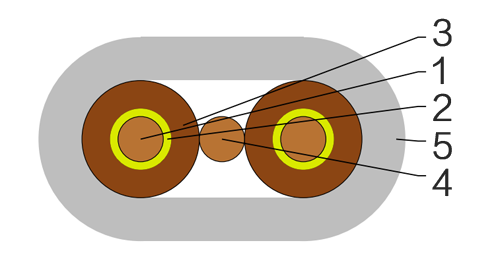
This range comprises two or three insulated
copper cores and a separate bare copper
circuit protective conductor (CPC),
enclosed within an LSZH outer sheath.
Typical project environments include
hospitals, hotels, high-rise buildings,
airports, metro facilities and power stations.
Each insulated core incorporates a mica glass
tape fire barrier beneath the XLPE insulation.
The barrier helps preserve electrical insulation
during fire exposure.
The LSZH sheath helps limit smoke emission
and halogen acid gas release during burning.
The basic cable design is adapted from
BS 7211:2012. The catalogue lists BS 6387
and IEC 60331-21 as circuit integrity
test references.
The required test method, classification
and fire duration must be confirmed against
the relevant test report for the supplied cable.
This is an unarmoured fixed installation cable.
Provide additional mechanical protection
where required by the installation conditions.
For fire-resistant wiring systems, cable supports,
joints and terminations should be selected
to suit the specified circuit duty.
Select the cable according to voltage rating,
number of insulated cores, main conductor size,
CPC size, installation conditions and the
project fire performance requirements.
Basic design adapted from BS 7211:2012
| Circuit Integrity | IEC 60331-21; BS 6387 |
| Flame Retardance (Single vertical wire or cable test) | IEC 60332-1-2; EN 60332-1-2 |
| Reduced Fire Propagation (Vertically-mounted bundled wires & cables test) | IEC 60332-3-24; EN 60332-3-24 |
| Halogen free | IEC 60754-1; EN 50267-2-1 |
| No Corrosive Gas Emission | IEC60754-2; EN 50267-2-2 |
| Minimum Smoke Emission | IEC 61034-2; EN 61034-2 |
FIRE PERFORMANCE NOTE
The catalogue lists BS 6387 and IEC 60331-21
as circuit integrity test references.
IEC 60331-21 is a legacy reference.
The applicable standard edition, classification
and fire duration must be confirmed against
project requirements and the relevant
cable test report.
A specific CWZ classification or fire duration
must not be assumed from the product name
or the presence of mica tape alone.
300/500V
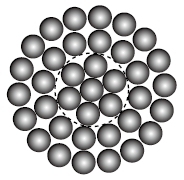
Conductor : Annealed copper conductor, solid or stranded according to BS EN 60228 class 1 or class 2.
Fire Barrier : Mica glass tape.
Insulation : XLPE type GP 8 according to BS 7655-1.3. Crosslinked polyolefin material type EI 5 according to EN 50363-5 can be offered as option.
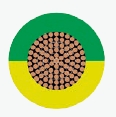
CPC (Circuit Protective Conductor) : Uninsulated copper conductor.
Outer Sheath : Extruded LSZH type LTS 2 according to BS 7655-6.1.
Outer Sheath Option : UV resistance, hydrocarbon resistance, oil resistance, anti-rodent and anti-termite properties can be offered as option.
Insulation Colour :
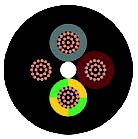
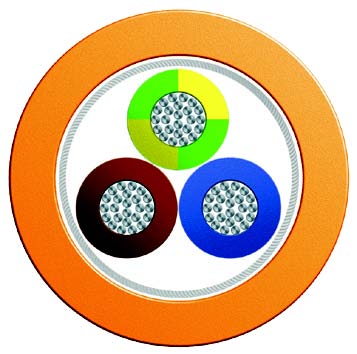
Twin : Brown and blue or, for 2x1.0 and 2x1.5 cables, brown and brown.
Three cores : Brown, black (centre core) and grey.
Position of CPC :
Twin : Centrally placed between cores in same plane.
Three cores : Centrally placed between black and grey cores in same plane.
Sheath Colour : White; other colours can be offered upon request.
Maximum temperature range during operation : 90°C
Maximum short circuit temperature (5 Seconds) : 250°C
Minimum bending radius :
OD<8mm : 4 × Overall Diameter
8mm≤OD≤12mm : 5 × Overall Diameter
OD>12mm : 6 × Overall Diameter
| Conductor | FRP300-mRZ1-U/R | |||||||
|---|---|---|---|---|---|---|---|---|
| No. of Cores × Cross-sectional Area | Conductor Class | Nominal Insulation Thickness | Crosssectional Area of CPC | Class of CPC | Nominal Sheath Thickness | Min. Overall Dimensions | Max. Overall Dimensions | Approx. Weight |
| No.×mm² | mm | mm² | mm | mm | mm | kg/km | ||
| 2×1.0 | 1 | 0.7 | 1.0 | 1 | 0.9 | 5.1×9.6 | 6.0×11.2 | 84 |
| 2×1.5 | 1 | 0.7 | 1.0 | 1 | 0.9 | 5.4×10.1 | 6.3×11.7 | 101 |
| 2×2.5 | 1 | 0.7 | 1.5 | 1 | 1.0 | 5.9×11.3 | 7.0×12.2 | 136 |
| 3×1.0 | 1 | 0.7 | 1.0 | 1 | 0.9 | 5.1×13.0 | 6.0×15.1 | 108 |
| 3×1.5 | 1 | 0.7 | 1.0 | 1 | 0.9 | 5.4×13.7 | 6.3×15.9 | 135 |
| 3×2.5 | 1 | 0.7 | 1.5 | 1 | 1.0 | 5.9×15.0 | 7.0×17.6 | 190 |
| 2×1.0 | 2 | 0.7 | 1.0 | 1 | 0.9 | 5.2×9.8 | 6.1×11.4 | 89 |
| 2×1.5 | 2 | 0.7 | 1.0 | 1 | 0.9 | 5.5×10.3 | 6.4×12.0 | 107 |
| 2×2.5 | 2 | 0.7 | 1.5 | 1 | 1.0 | 6.0×11.5 | 7.1×13.4 | 141 |
| 2×4 | 2 | 0.7 | 1.5 | 1 | 1.0 | 6.5×12.4 | 7.7×14.6 | 181 |
| 2×6 | 2 | 0.7 | 2.5 | 1 | 1.1 | 7.2×14.0 | 8.5×16.6 | 256 |
| 2×10 | 2 | 0.7 | 4.0 | 2 | 1.2 | 8.3×16.5 | 9.8×19.5 | 406 |
| 2×16 | 2 | 0.7 | 6.0 | 2 | 1.3 | 9.4×19.0 | 11.1×22.5 | 576 |
| 3×4 | 2 | 0.7 | 1.5 | 1 | 1.0 | 6.5×17.0 | 7.7×19.9 | 216 |
| 3×6 | 2 | 0.7 | 2.5 | 1 | 1.1 | 7.2×19.2 | 7.5×22.5 | 311 |
| 3×10 | 2 | 0.7 | 4.0 | 2 | 1.2 | 8.3×22.5 | 9.8×26.6 | 460 |
| 3×16 | 2 | 0.7 | 6.0 | 2 | 1.3 | 9.4×25.8 | 11.1×30.6 | 690 |
Conductor operating temperature : 90°C
Ambient temperature : 30°C
| Conductor cross-sectional area | Ref. Method A (enclosed in conduit in thermally insulating wall etc.) | Ref. Method B (enclosed in conduit on a wall or in trunking etc.) | Ref. Method C (clipped direct) | Ref. Method E (in free air or on a perforated cable tray etc. horizontal or vertical) | ||||
|---|---|---|---|---|---|---|---|---|
| 1 two-core cable*, single-phase a.c. or d.c. | 1 three-or four core cable*, three-phase a.c. | 1 two-core cable*, single-phase a.c. or d.c. | 1 three-or four core cable*, three-phase a.c. | 1 two-core cable*, single-phase a.c. or d.c. | 1 three-or four core cable*, three-phase a.c. | 1 two-core cable*, single-phase a.c. or d.c. | 1 three-or four core cable*, three-phase a.c. | |
| 1 | 2 | 3 | 4 | 5 | 6 | 7 | 8 | 9 |
| mm² | A | A | A | A | A | A | A | A |
| 1.0 | 14.5 | 13 | 17 | 15 | 19 | 17 | 21 | 18 |
| 1.5 | 18.5 | 16.5 | 22 | 19.5 | 24 | 22 | 26 | 23 |
| 2.5 | 25 | 22 | 30 | 26 | 33 | 30 | 36 | 32 |
| 4 | 33 | 30 | 40 | 35 | 45 | 40 | 49 | 42 |
| 6 | 42 | 38 | 51 | 44 | 58 | 52 | 63 | 54 |
| 10 | 57 | 51 | 69 | 60 | 80 | 71 | 86 | 75 |
| 16 | 76 | 68 | 91 | 80 | 107 | 96 | 115 | 100 |
Note: *With or without a protective conductor.
| Conductor cross-sectional area | Two-core cable, d.c. | Two-core cable, single-phase a.c. | Three- or four-core cable, three-phase a.c. |
|---|---|---|---|
| 1 | 2 | 3 | 4 |
| mm² | mV/A/m | mV/A/m | mV/A/m |
| 1.0 | 46 | 46 | 46 |
| 1.5 | 31 | 31 | 31 |
KEY FEATURES
- 300/500V rated voltage
- Two or three insulated cores plus a bare copper CPC
- Class 1 solid or Class 2 stranded copper main conductors
- Mica glass tape fire barrier
- XLPE insulation and LSZH outer sheath
- Unarmoured construction for fixed installation
- Basic design adapted from BS 7211
- Fire performance confirmed against the relevant test report
SELECTION NOTES
For quotation, specify the number of insulated
cores, main conductor cross-sectional area,
CPC cross-sectional area and total cable length.
Confirm whether Class 1 solid or Class 2
stranded main conductors are required.
Provide the required circuit integrity
test standard, classification and duration.
Also confirm insulation colours, sheath colour,
installation environment, packing requirements
and delivery destination.
The CPC is a protective conductor.
It must not be treated as an additional
insulated circuit core or neutral conductor.
Outdoor exposure, wet locations and underground
installation require assessment of the cable
construction and installation protection.
Additional UV, oil or chemical resistance
must be specified and confirmed before supply.
RELATED CABLE TYPES
300/500V Mica XLPE LSZH Single Core Cable with CPC
450/750V Mica XLPE LSZH Single Core Cable
450/750V Mica XLPE LSZH Multicore Cable
BS7211 LSZH Fixed Wiring Cable
FAQ
How many cores does this cable have?
This range has two or three insulated cores,
plus a separate bare copper circuit protective
conductor (CPC).
The CPC is not included in the stated number
of insulated cores.
What is the difference between the two versions?
The two-core version contains two insulated
cores plus CPC.
The three-core version contains three insulated
cores plus CPC.
Choose the configuration according to the
circuit design and required core identification.
Are the main conductors solid or stranded?
The catalogue includes Class 1 solid and
Class 2 stranded copper main conductors.
Confirm the conductor class and available
cross-sectional area before ordering.
What is the purpose of the mica tape?
Mica glass tape forms a fire barrier beneath
the XLPE insulation.
It helps preserve electrical insulation
during fire exposure. The resulting circuit
integrity performance must be supported
by testing of the cable construction.
Is LSZH performance the same as fire resistance?
No. LSZH concerns smoke and halogen-related
emissions during burning.
Fire resistance concerns maintaining circuit
integrity under defined fire test conditions.
These are separate performance requirements.
What standards are referenced for this cable?
The basic design is adapted from BS 7211:2012.
The catalogue lists BS 6387 and IEC 60331-21
as circuit integrity test references.
IEC 60331-21 is a legacy reference.
Confirm the applicable standard edition
and required performance before ordering.
Does this cable automatically have a CWZ rating?
No specific CWZ classification or fire duration
should be assumed from the catalogue title
or the presence of mica tape alone.
The required rating must be verified against
the relevant test report.
Is this cable armoured?
No. This is an unarmoured LSZH sheathed cable
with a separate bare copper CPC.
Additional mechanical protection should be
provided where required by the installation.
How do I request a quotation from BURYCABLE?
Send the required core configuration,
main conductor size, CPC size, conductor class,
cable length and fire performance requirements.
Include the installation environment,
colour requirements, packing details
and delivery destination.